Main menu
You are here
Effective Political Secularism
 I give thanks to John Perkins for inviting me to present tonight at the Atheist Society on the topic of "Effective Political Secularism" at this venue, the Melbourne Unitarian Church hall. It is a rather marvellous convergence of interests across the metaphysical spectrum, but I hope, in the course of this evening's presentation, that a sort of unity of interests and understanding between different worldviews can be reached. I will acknowledge in the interests of transparency, that John and I have worked together on secular issues for a number of years. I was the founder of the Victorian Secular Lobby, an incorporated association, in 2011 and president of that association from 2012 to 2022. Over those years, the Victorian Secular Lobby organised religious leaders in favour of marriage equality, our first campaign, the issue of religious education in public schools, the dying with dignity campaign, the campaign against school chaplains in public schools, the suppression of sexual offences by clergy and the disingenuous avoidance of legal responsibility, a campaign against discrimination in religious schools and organisations, campaigns against anti-secular PMs in state elections, and against the automatic provision of charitable tax deductibility for organisations promoting religion, a legal right heavily abused by organisations like the Australian Christian Lobby. In the history of our organisation we were largely successful in our participation in many of these campaigns, albeit not all of them.
Perhaps it will be seen as a little unusual from the outset to be presenting to an atheist society a position that is, effectively, not atheistic. There are, of course, wide varieties of atheism, although perhaps not to the same extent as there are varieties of theism. It would be fair, however, to suggest that atheism represents an absence of belief in deities, or, in the narrow sense, a belief that there are no deities. This definition differs substantially from secularism, the personal, community, and legal separation of civil affairs from legal and political institutions and processes. Whereas atheism engages and debates with theism on the matters of metaphysics, transcendence and immanence, personal or impersonal, or divine intervention, secularism does not. Rather, secularism is a matter of how we as individuals and as a community establish the rules and procedures of religious organisations. Whereas it would seem to be a contradiction to be an atheist theist or a theist atheist (at least in most cases of a transcendent personal god), there is no such contradiction in being a secular theist or a secular atheist. On this point, there is potential unity.
We also find many situations where people, due to cultural context, can find themselves participating in various religious-inspired events and holidays even if they do not match their worldview. Richard Dawkins, a very avowed atheist, once described himself as a "cultural Christian" and even a "cultural Anglican", insofar that he engaged in holiday celebrations such as Christmas and ethos. To quote Dawkins from 2024, "I'm not a believer, but there is a distinction between being a believing Christian and a cultural Christian ... I love hymns and Christmas carols, and I sort of feel at home in the Christian ethos, and I feel that we are a Christian country in that sense". It is certainly worth adding at this point that he also drew a strict comparison and opposition to Islam in this context, which is illustrative of the limited range of his cultural experience. It is more than plausible to suggest that most people, even of a nominal religious position, are in this category of cultural practitioners and that most people incorporate the religion of their culture, even if they don't believe the metaphysical assumptions.
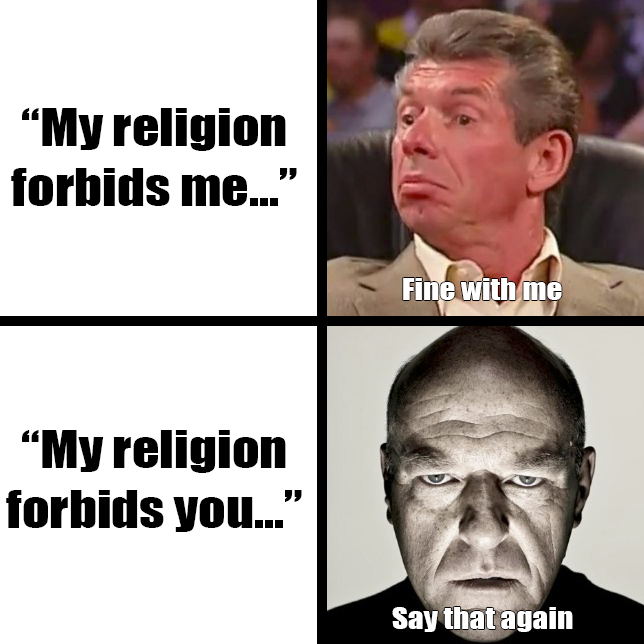
A further narrowing of the discussion must occur at this point. Not only does this presentation draw a distinction between the difference of theism and atheism, this presentation is not about "secularism" as a cultural whole, but rather the narrower issue of "political secularism", that is the legal and civic norms and institutions of a society, distinct from various individual and cultural behaviours. The very significant point is taken that "politics is downstream from culture"; the participation or non-participation in religious organisations is not the concern of political secularism, but rather there is the need for a cultural norm where differences in religious views are not expressed in preferential treatment in the legal rights of civic organisations. From the outset, this cultural norm represents a necessary and sufficient condition for political secularism to succeed, that is, in order to be effective.
It is opportune at this point to raise two examples of ineffectual examples of pseudo-secularism, both of which had widespread implementation. The first is the attempt to proportion religious power among different religious factions, co-confessionalism, within a country with an interest in social peace. An example of such an approach can be found in Lebanon and, in a different sectarian manner, Israel. Another version is found in the implementation of State Atheism, typically found in the communist-controlled states such as the Soviet Union and the Peoples' Republic of China. Further, and moving into the realm of varieties of secularism, the laïcité ([la.i.si.te] model with French and Turkish variants, the continuum of semi-secularism, and the model of accommodationism are notable in the United States. All of these stand in contrast to the existence state religions, or confessional state, where a particular religion is endorsed by the State; this includes Islamic states such as Saudi Arabia, Iran, Iraq, Egypt, Libya, Algeria, Pakistan, and Bangladesh, in Christian states such as Denmark, the United Kingdom (Anglican for England, Calvinism for Scotland), and Papua New Guinea, in Buddhist states such as Thailand, Myanmar, Cambodia, and Sri Lanka. Note that having a state religion does not imply that a country is a theocracy where civil and political authority is vested in religious edict, "theocracy" means "rule of God"; that is, Afghanistan, Iran, Saudi Arabia, and Mauritania. These examples are the most non-secular jurisdictions.
In the case of Lebanon's example of proportional religious empowerment, freedom of religion is curiously protected by the Constitution, but not freedom from religion. One must belong to one of eighteen recognised sects, which include Shi'a and Sunni Muslims at about 27% each, Druze at 5.5%, Maronite Christians at 21%, 8% Greek Orthodox, 5% Melkite Christians, 4% Armenian Christians, and others. These religious groups who are permitted to exercise authority over matters pertaining to personal status, such as marriage, divorce, child custody, and inheritance. Political power is distributed with the position of president is reserved for a Maronite Christian, the Presidency of Parliament for a Shiite Muslim, and the Prime Minister for a Sunni Muslim. Unrecognised groups, such as Baháʼís, Buddhists, and Hindus, may own property and assemble for worship; legally, they may not marry, divorce, or inherit property in the country, and there are no procedures for civil marriage. Notably Lebanon has a secularist movement, Laïque Pride, that has organised rallied for "an end to the country's deep-rooted sectarian system" and for a "secular Lebanon". The organisation encourages. "Evangelical Secularism", that is a culture of contrasting secularism with sectarianism rather than religion as a whole and aims to promote a "culture of secularism" in the public sphere, before the implementation of institutional and political change.
In contrast, State Atheism, once far more prevalent as the official practise in the Soviet Union, the Eastern Bloc, and a number of Soviet-supported states in Africa, is now restricted to the People's Republic of China, Vietnam, and North Korea. In some ways, the opposite of theocracy and in others a mirror-image, State Atheism took the ambivalence of religion in Marx and converted it into the goal of the abolition of religion as a reactionary force. Marx's comments on religion must be noted at this point as they are often poorly understood, as he understood religion as both addictive, but also with its healing properties, and that religious solace was a reflection and escape from material suffering: "Religious suffering is, at one and the same time, the expression of real suffering and a protest against real suffering. Religion is the sigh of the oppressed creature, the heart of a heartless world, and the soul of soulless conditions. It is the opium of the people."
Under State Atheist regimes, the official objective of elimination of religion through destroying or converting places of worship, of executing or imprisoning religious leaders, of excluding religion from scholastic institutions, was common. But even where State Atheism has been practised there has been a role for religious organisations; after years of persecution Stalin partially rehabilitated the Orthodox faith to inspire the population during the second world war. China allows state-sanctioned religious organisations: Buddhist, Taoist, Islamic, Protestant, and Catholic. Whilst there is a visceral recognition of the gross abuses of human rights that have occurred under the name of State Atheism - which must include hundreds of thousands of deaths specifically under targeted anti-religious campaigns - from a secular and sociological perspective the greatest weakness of State Atheism is that it concentrated entirely on the institutional enforcement of atheism and irreligion, rather than the cultural engagement of secularism. In other words, the atheist state did not have a secular culture.
The next model under consider is French and Turkish Laïcité, from the Ancient Hellenic "laïkós", meaning "layperson" or "non-cleric". It is a variant of secularism, insofar that it forbids religious involvement in the determination of state policies, or the establishment of a state religion, or government involvement in religious affairs, and especially prohibits government influence in the determination of religion. Article 1 of the French Constitution states: "France shall be an indivisible, secular, democratic and social Republic. It shall ensure the equality of all citizens before the law, without distinction of origin, race or religion. It shall respect all beliefs." This is the liberal version of the term; however, a more radical version veers close to State Atheism and with similar problems, and that is the radical version (laïcard) sees it as prohibiting religious expression in public spaces. For example, since 2004, conspicuous religious symbols, including headscarves, kippahs, crosses, turbans, or religious habits, are banned in public schools. Inspired by the French model, the founder of modern Turkey, Mustafa Kemal Atatürk, adopted a version of laicism as a constitutional principle, which initially had a strong anti-religious approach banning pilgrimages and religious education, and even the wearing of the fez (which was also banned for similar reasons by the Nasser government of Egypt). In Turkey, over time, the state institutionalised control over Islam, effectively nationalising religion.
The more common experience for those in the developed Anglophone, such as the United States, the United Kingdom, Canada, Australia, New Zealand, etc. is the existence of semi-secular states with accomodationism. In these examples, the culture is already largely, but not exclusively, secular and certainly in Australia's case, with more than a dash of religious irreverence, especially among working-class people. There are advantages, and often significant advantages, for religious institutions. Many of these are very far from the daily experience of citizens, such as the requirement that the head of state must be a member of (for example) the Church of England. But others experiences are very immediate and powerful, and it is on those that secular organisations must concentrate. The most powerful of these is the charitable status awarded to religious organisations in virtue of being religious organisations. This has allowed public funds to be selectively diverted from the largely secular government toward the promotion of sectarian and discriminatory practises and ideology. It is notable, for example, that the High Court allowed for the funding of religious schools on the grounds that they provided a secular education, the very same religious schools also wanted the right to discriminate against students and teachers that did not follow the edicts of their faith.
This is an example of a semi-secularism that accommodates and therefore encourages religion. The tax deductibility of religious organisations should be based on genuinely charitable activities, such as welfare for the poor, healthcare for aged, the education for children, all of which they must carry out without discrimination in order to be considered charitable. An argument has been raised on whether religious services should be treated as a type of dramatic art, and therefore deserving of tax deductibility on that basis. If they are of sufficient artistic merit, such an argument can be entertained - pardon the unintentional pun - but that should not a matter of aesthetic judgement and quality, not of religious belief. It is quite evident that the accommodationist approach has converted religion, especially in the United States and increasingly so in Australia, and the strength of popular rejection of such an approach.
The problem being, of course, that religious organisations are financially very powerful and exceptionally well-organised, and they will fight tooth and nail for advantage. Thus, any secular organisations likewise have to be well-organised, pick their targets on both principle and probability of success, and arrange their finances for effective campaigning. An extremely important point that should arise from the discussion of the various models tonight is that in order to succeed, the culture of secularism must be distinct from the debate between theism and atheism, or the enforcement of irreligion, or seeking a power-sharing arrangement. Secular theists must be as welcome as secular atheists in order for any secular campaign to succeed. Atheism may very well win a cerebral debate or even extend the power of disdain and mockery, but that is not the objective here, and nor should it be. Popular support for secular principles and culture needs to harnessed and, if criticism can be made of Australia's National Secular Lobby, is that it has concentrated too heavily on the "lobbying" side and gaining high-profile "ambassadors" to the cause - as valuable as that might be - but at the expense of encouraging popular involvement and engagement. For secularism to succeed, there must be an engaged secular culture that has carried out the debate in the public sphere against sectarianism.
Which brings one to a final point, very far from our immediate experience, and that is what to do about theocracies, where the very act of engaging in public debate about such matters is fraught with often very visceral difficulties. The case of contemporary Iran is especially illustrative here. Contemporary Iran is a horrendous theocracy, a country that has been in political decline ever since the coup against the Mosaddegh government in the 1950s to the present day. The Iranian people, and especially Iranian women, with incredible bravery and against mortal levels of State violent have stood up for their rights. Whilst the United States and their allies have tried to claim that one of their reasons for their war against Iran has been these real humanitarian reasons, nobody is buying that excuse; of the US were really concerned about civilian life, it would be looking at Israeli actions in Gaza with an even greater stick. Attempting to enforce regime change through an outside government leads to a "rally around the flag" response, and today the Iranian regime has been empowered by the US's war of aggression. As the experience of Afghanistan and Iraq illustrates, change must come from within; if one is genuinely serious about supporting the Iranian people, then there are organisations like the "Woman, Life, Freedom " movement, secular-democratic groups like the "Freedom Movement of Iran", and for workers' rights, the independent "Free Union of Iranian Workers".
This presentation, effective political secularism, has highlighted the distinction between atheism, theism, and secularism, and identified several approaches to governance of religious matters, including theocracies, religious states, co-confessionalism, state atheism, laïcité, semi-secularism and accomodationism. It has argued that politics is downstream from culture, and that generating a culture of secularism and being opposed to sectarianism is a more effective primary approach than the enforcement of irreligion in institutions and laws, but at the same time recognising that secularism must be implemented in civil procedures in order to be political. The presentation has noted that laïcité runs the risk of veering toward state atheism, whereas accommodationism runs the risk of empowering religious organisations in a manner that undermines the secular state, and veers towards a religious state. In order for secularism to succeed, it must be an organised, and mass movement, that has a broad and non-discriminatory reach, that does not exclude people for their religious beliefs or lack thereof. Finally, with regard to theocratic states, the point is made that attempting regime change from without threatens decades of civil war and a loss of the internal secular movement as independent and indigenous to the country. With these matters in mind, it is hoped that all can work together toward a genuinely secular future where concerns are focused on life in this world.
Presentation to the Atheist Society of Victoria, September 9, 2026 the Melbourne Unitarian Church Hall
- Log in to post comments
Comments
Elaboration: Les Allen's
Elaboration: Les Allen's remark that public officials in positions of authority (teachers, judges, police, etc) should not have religious symbols on display makes a lot of sense from a secular perspective, as it represents an implicit communication from a non-neutral position.