Main menu
You are here
Iran: 75 Years of Political Decline (Part One)
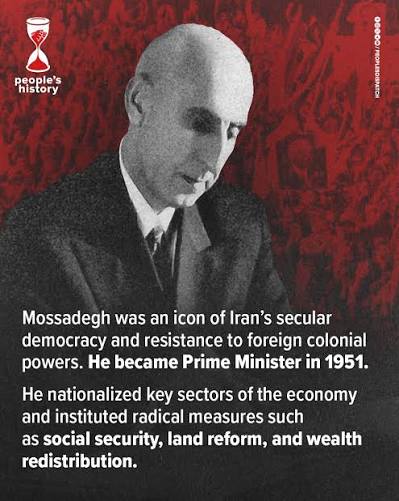 Any serious understanding of Iran must begin with the nationalist, secular, and social democratic government of Mohammad Mosaddegh from 1951-1953. If it seems strange to start a discussion of a contemporary war on events from 75 years ago, but everything flows in an unbroken chain from Mosaddegh's election as Prime Minister, the 1953 Iranian coup d'état backed by United Kingdom (MI6) and the United States (CIA), the re-empowerment of the monarchy and the Consortium Agreement with Western oil companies, the modernisation "White Revolution" of 1963, the Iranian Islamic Revolution of 1979 and subsequent Islamicist Cultural Revolution, the opposition Iranian Green Movement of 2009, and finally the 2025-2026 Iranian protests, the suppression, and the contemporary war.
It has to be recognised that every successive regime following Mosaddegh has been worse than the one previous. The short-lived Mosaddegh government, having already introduced social security and land-value taxation, sought the nationalisation of Iran's oil reserves and an audit of the Anglo-Iranian Oil Company's royalty payments. The British, through M16, sought to overthrow the government and sough the support the United States, through the CIA, with the critical pretext of a highly questionable referendum carried out by the Mosaddegh government. The two agencies co-operated and empowered Raeza Pahlavi, the Shah of Iran, who would then rule Iran as a pro-Western monarch. The Shah, initially opposed to the coup and supporting oil nationalisation, was both threatened and awed by the power and reach of the Western imperial powers.
The price of US support for the coup led to the breakup of the AIOC and the implementation of the Consortium Agreement of 1954, where western foreign companies owned 40% of Iran's oil shares was owned by 5 American companies another 40% belonged to Iran-UK oil companies, 14% belonged to a Dutch oil company, and the remaining 6% belonged to a French oil company. Internally, the CIA initially organized anti-Communist guerrillas and then sent Major General Norman Schwarzkopf Sr. to train and fund SAVAK security forces, along with the French intelligence service, SDECE. SAVAK would be responsible for the torture and execution of thousands of political prisoners. Many of those in SAVAK would go on to be part of the Islamic regime's SAVAMA, Sazman-e Ettela'at va Amniat-e Melli-e Iran, the Ministry of Intelligence and National Security of Iran.
Despite this, the Shah did engage in a modernisation programme, "the White Revolution," which was launched in 1963. Key elements of this reform project included land reform, infrastructure expenditure, a public health programme, industrialisation, some workplace democracy, the enfranchisement of women, nationalisation of forests and pastures, public education and a literacy campaign. All these helped generate an impressive gain in Iran's economic development, industrialisation, and, with increased expenditure in military equipment, raised Iran to become a regional power. At the same time, many of the poorest farmers in rural areas did not benefit from the land reform and corruption was common. The main opposition, however, came from the religious Shī'a clergy, who not only lost much of their power in education and family law, but were also particularly critical of women voting and secular education, and because their leadership was strongly tied to the feudalistic landlord class. This opposition would manifest in demonstrations in June 1963 against the Shah.
There is a tragic irony that when the 1979 Islamic reactionary regime change occurred, the Shah's government had painted itself into a corner where it had little support. The Reza Shah government was authoritarian and dictatorial and Mosaddegh's political group, the National Front, had been outlawed and most of its leaders arrested, along with thousands from the communist Tudeh party. In the 1970s left-wing groups engaged in piecemeal armed actions against the regime, which were brutally suppressed. With the secular left suppressed, the religious right became the focal point against a regime that tried to rule from an authorian centre. Simultaneously able to promote itself as anti-Imperialist to those with left-nationalist views and anti-secular to those with religious conservative view, with the latter group holding actual control.
The degree that it was an fundamentalist Shi'a reaction become quickly apparent. After a year of protests and violent clashes, the Shah fled Iran and a new Islamic government, effectively led by Ruhollah Khomeini, took power and managed affairs through the secretive Council of the Islamic Revolution and then the Council of Guardians. In rapid succession, more democratic political parties (the National Democratic Front, the Muslim People's Republican Party) were banned, and the left-leaning President, Abolhassan Banisadr, was impeached. In response, leftist and regional guerrillas revolted, the most significant being the KDPI Kurdish uprising. During this time Iran both held the US embassy hostage and carried out a widespread series of executions against political opponents and dissidents, which would be followed up by an even more significant mass execution of political prisoners in 1988; all of which whilst Iran was in the midst of potracted war initiated by Saddam Hussein's Iraq; the United States providing military assistance to both sides. After eight years the war came to a conclusion with no change in territory; status quo ante bellum; half a million people had died.
Following the 1989 death of Ruhollah Khomeini, the Supreme Leader of Iran was Ayatollah Ali Khamenei, with Akbar Hashemi Rafsanjani governing as President from 1989 to 1997. Following the Iran-Iraq war, economic recoonstruction was a priority whilst maintaining strict societal control with dress codes enforced and new information technologies controlled. The scattered economy struggled with declining income, high inflation, and mismanagement. It was also the period that the Islamic Revolutionary Guard Corps (IRGC) expanded and deeply embedded itself into Iranian governance and economy. However, in 1997, Mohammad Khatami won the presidential election, advocating reform, civil rights, and press freedoms, with widespread support primarily from women, youth, leftists, liberals, and business leaders. Optimistically called "The Tehran Spring", Khatami also tried to open a dialogue with the world to further international relations, especially the "Dialogue Among Civilizations".
Khatami's presidency ran for two terms and during that time Iran experienced two significant protests led by students, in 1999 and 2003, both of which were subject to state suppression. The first arose after the closure of the reformist newspaper "Salam", that had provided quality investigative journalism concentrating on financial corruption and, in this case of its closure, had published an internal report revealing plans by the Ministry of Intelligence and Security to restrict the press. In 2003 the protests criticised the Khatami government as insufficient in its reforms, and demanded fresh democratic elections, economic and welfare rights, a free press, and end to police brutality. The protests were broken up by police and the Iran Revolutionary Guards.
- Log in to post comments