Main menu
You are here
Imperialism, Colonialism and Internationalism
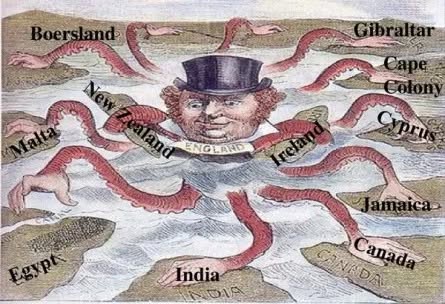 From the presentation to the Isocracy Annual General Meeting, March 25, 2026
As an Australian, I am acutely aware how the intersection between empire, colonies and our globalised world can be best exemplified in my country. The Commonwealth of Australia is the creation of the British Empire, the world’s most successful global colonial empire. And it wasn't a coincidence that this happened, redcoats had to travel halfway across the world, gun down the Wurundjeri and Bunurong people, for me to present to you. But before King and Country get upset and call what happened "settlement", a discussion of imperialism is in order, wherein I will define the qualities that make an empire.
Empire
Four thousand three hundred years ago, near the modern-day city of Hillah in Iraq, there stood a city called Akkad. And inside the clay walls and palaces of this city was a man history knows as Sargon. He established what is considered the world’s first empire. I would now like to recite to you some of the ancient inscriptions that describe him:
Sargon, king of Akkade, … king of the world … lord of the land
conquered the city of Uruk and destroyed its walls.
He was victorious over Uruk in battle, conquered the city,
captured Lugalzagesi, king of Uruk, in battle and led him off … in a neck stock.
Sargon, king of Akkade,
was victorious over Ur in battle, conquered the city and destroyed its wall.
He conquered Eninmar, destroyed its walls,
and conquered its district and Lagaš as far as the sea.
He washed his weapons in the sea.
He was victorious over Umma in battle, conquered the city, and destroyed its walls.
To Sargon, lord of the land, the god Enlil gave no rival.
The god Enlil gave to him the Upper Sea and the Lower Sea
so that from the Lower Sea to the Upper Sea, the citizens of Akkade held the governorships of the land.
Mari and Elam stood before Sargon, lord of the land
Sargon, king of the world, was victorious in 34 battles.
He destroyed their walls as far as the shore of the sea.
5400 men eat daily in the presence of Sargon, the king to whom Enlil gave no rival.
What a guy - you win a couple of dozen cities, and now you're the king of the world? This ego reminds me of a certain orange man. But here you can see how all the ingredients of the empire were already established. Violence, control and the exploitation of foreign lands. The defining feature an empire is that it has control over numerous diverse peoples. Sargon of Akkad, from the middle of Iraq, conquered all of the peoples from the Mediterranean Sea to the Persian Gulf. Mari referred to those living in modern Syria who spoke an Eastern Semitic language. The Elamites lived in lands that are now south-western Iran. No matter when, no matter how, the Iranian people are going to be victims of the empire. But imagine how many different languages were spoken? What did the many people of the different cultures there call themselves? Who were their gods, values and customs?
Throughout history, there have been countless individuals of various cultures who have been conquered and the victims of imperialism. These people are actually a fundamental building block of the empire. A king can rule over his own people. But an emperor rules over many people. The ugly truth is that an empire exerts control predominantly through violence. Sargon of Akkad had an army of 5,400 soldiers. His military forces could march from sea to sea, destroy walls and conquer cities. From Maces to chariots, to crossbows, catapults, cannons, gunboats, bombers and now drones. Now armies can exceed a million soldiers, project force over all the continents of the earth, destroy cities and conquer nations. It is terrifying how, as history progresses, things don’t really change; things only become more lethal. Whilst economic, cultural or religious means of coercion can also be utilised to control people; it is violence which is the currency of empire.
Who leads an empire? An empire has a centralised body for making power. Normally, an empire is ruled by an emperor. Depending on the cultural context, these people can be called many things – Caesar, Wang Tung, Sultan, Tsar, Khan. However, not all empires have an emperor, some empires are controlled by a senate, or a house of commons, or congress. What is important is that power flows from the very top down to the bottom. Empires aren't democracies; the common people do not affect decision-making at all, unless, of course, it is through force of arms. Exploitation is inherent to empire. Those in the periphery are subservient to the core.
Whilst empires can contribute to the flourishing of conquered peoples, the main priority is wealth extraction. This is not a confederation, alliance or coalition. An empire is by nature an exploitative system. Whilst the desire to export one's own culture or religion is often a strong driver for imperialism, armies do not subjugate foreign peoples for those reasons alone, no matter how fiercely some try to argue that. The pursuit of wealth and the indulgence of greed lie at the soul of the empire. These selfish wants are often not only harboured by the rich and few, but also by the poor and many. And how many ordinary people have promoted an empire for reasons of personal gain? Growing the borders of an empire is what satiates the desires of these imperialistic peoples.
Internationalism
I'd be remiss to not recognise how topical imperialism is in today’s context. All around the world, empires are still at work; well, one empire. But stepping away from imperialism, I seek to discuss a more upbeat topic. All around the world, I also see those who want to see new places and meet different people. The ingenuity of man is not limited to war, but also in the field of travel. Who loves a good holiday?
We love going to Europe, or Japan, or Dubai. Well, maybe not Dubai anymore. As a typical Australian, I like to travel and had a fun trip during the last holiday period. I went to Darwin for a vacation and had a swell old time. Went to waterfalls and even saw the famous jumping crocodiles. Didn’t even know they could jump, but it went up to this high. But what I find more amazing is that the flight from Melbourne to Darwin only took me a short plane trip of 3 hours. In 1897, this journey would take 6 weeks by boat.
As humanity progressed in technological sophistication, the world became smaller as people discovered ways to access distant places in shorter and shorter periods of time. Since the times of Sargon of Akkad, mankind has crossed the oceans, mapped out the deserts and put even the densest of jungles onto Google maps. Where once only a select number of people could spend their entire life only traversing but a fifth of the world, now I can hop onto a plane and fly that same distance in daylight hours. If a commercial plane didn't have to refuel and pilots didn't have to sleep, a plane could circumnavigate this Earth in 44 hours. Imagine that, in 2 days, you can travel 40,000km. Beats traversing around the world in 80 days. As travel becomes easier, there are many reasons for countries and people to increase cooperation with one another.
This is exemplified by internationalism, the non-socialist kind. Internationalists want to eliminate boundaries in order to achieve a higher level of human connectivity. Think of all the differences that are stopping all people from achieving world peace. Colour, race, class, politics, cultures, religion, nationalities. Many live and die by their biases, but these things mean so little. Shouldn’t people put aside their differences for bigger and better things? There are great reasons why cooperation among states and nations should be increased. Think of all the biggest companies on earth right now. NVIDIA, TSMC, Broadcom, and Saudi Aramco. They have net worths that is more than most countries on Earth. And they are not alone. Dozens of companies can be argued to have more influence than many nations.
Humanity is facing some of the greatest challenges it has ever witnessed in our 300,000-year history. Climate change, though not new to Earth, is the greatest risk to the survival of our species. Disease, war and famine - those 3 horseman - have never stopped riding alongside us. And now wealth inequality and corruption on a global scale are fast destroying civilisation as well. Countries cannot tackle these challenges alone. No one group of people can tackle the problems that we all face. And I don’t think companies or stakeholders are the answer.
Colonisation
Increasing cooperation amongst all of Earth's inhabitants is a good thing. However, can true cooperation occur between two parties of unequal power? What if one party is the native inhabitants of a land, and foreigners came to dominate them? What if these foreigners didn’t just come to exert control but also to mass emigrate and supplant you from your lands? This is the reality millions of indigenous peoples have suffered for the past centuries.
Colonisation has existed for millennium but the one we think of today is a relatively new invention. It was pioneered by the Portuguese when technological advances in maritime technology enabled them to trade on an international level. They established factories, outposts, and colonies in Brazil, Africa, the Middle East, India, Southeast Asia and East Asia. The Portuguese were the first but not the last. Spain’s colonial efforts killed and enslaved millions in South America. France continues its quest for colonialisation even now in West Africa through neo-colonialism. And of course, the British, what more do I need to say. 500 years later, only 14 countries on this Earth are not the victims or perpetrators of colonisation. That’s only 7%. Colonial empires have left their stain on humanity. Colonisation and imperialism are extremely similar. The key difference is that the coloniser displaces either the elite of the indigenous population or the population itself.
Furthermore, European colonisation had a racial dimension which irreversible poisoned every society it touched. Notions of language, colour, race, civilisation and barbarity became all mixed into one. Colonisation is a product of greed and technology. It is unnatural and artificial; no one ever wants to be a product of a foreign people’s wants. To be enslaved, dehumanised and made inferior. Some, like the poet Rudyard Kipling, interpreted the colonial project of Britain and the civilisation effort. Others, such as the Catholic church, viewed it as a Christian mission to save the souls of the non-believers. But there was no manifest destiny or divine plan. Colonisation's main goals were, and still are, trade, wealth extraction and power.
Colonisation primarily took on two forms: the Old World and the New World. In America and Australia, the population of the native inhabitants were decimated by disease. By the time the coloniser was able to establish permanent settlements, resistance from the locals had diminished. Any conflict that arose became remarkably one-sided. The resulting settler societies became decidedly monocultured, white. Australia is one of these settler colonies – in Tasmania, all the First Nations people died, a product of a genocide. In Asia and Africa, the coloniser was unable to rely on disease to gain a decisive advantage. So instead of absolute domination, they had to settle for hegemony. The locals were still many, but, temporarily, not the strong. Independence movements in the 20th and 21st centuries allowed them to, nominally, cast off the yoke of colonisation.
Neo-colonial empires
Colonial empires of the past directly exploited their colonies. Now there are no more colonies, but that does not mean colonial empires have diminished. Rather, they have morphed into new actors who harness modern methods. Culture moulds the way you think, money how you are able to live, war what safety you can afford, and science the avenues of your future. These indirect methods now control the lives of billions. Rather than Great Britain is gone the British global finance regime is still emplaced. The French Empire is a thing of the past, but its stranglehold on West Africa is still strong, as exemplified by its control of the CFA franc. And America, that city upon a hill, now only bombs cities.
A fun fact about myself – I am of Vietnamese descent. I'm from a refugee family who fled communist Vietnam in the 1980s. And like many Vietnamese families, we were once bombed by the US Air Force in the past. It was around the Lunar New Year in 1968, and the whole family was home. Then the Tet Offensive occurred, and luckily, Grandpa had the money and brains to build a bunker under the house. Good thing too because the family home blew up. The neighbours thought we all died. The Vietnamese people still think a lot about the Vietnam War, or the American War, as locals now call it. Ho Chi Minh initially wanted to cooperate with the Americans to build a better Vietnam. But we all know what happened after. South Vietnam – the Republic of Vietnam – was a failed American puppet. Cuba is another one of those. After liberating Cuba from the Spanish, America would ensure that only loyal dictators ruled their new playground for the rich. After Fidel came into power, Cuba became a Soviet satellite state. Havana became highly dependent on Moscow’s assistance. It's sad, but the people of Cuba traded one whip for another. And throughout this time, America still imposed embargoes and sanctions on the island. Neo-colonisation is a game of winners, but mostly losers. The Socialist Republic of Vietnam has managed to succeed, but the Republic of Cuba still suffers. America is now friends with one but hates the other. The imperial colonial powers are still strong, and they are still out there.
Ending
This is the world that is. One who lives in the shadow of colonial empires. And must endure the tendrils of neo-colonialism. Globalisation has resulted in great achievements for humankind. But has also enabled the worst crimes imaginable. Let us remember all the victims who continue to suffer now. Whether they are in Cuba, Lebanon or Iran – let us begin.
In the course of writing and presenting this speech I want people listening to remember one thing. Don’t focus on the empires or the exploitation. Think of the ordinary people. It is they who deserve our attention the most.
- Log in to post comments